 All guides & resources →
All guides & resources →
All guides & resources →
For six months a white city of palaces stood on the lakefront where a swamp had been two years before, and something like twenty-seven million admissions passed through its gates when the whole country held about sixty-three million people. Then most of it burned. This is the long version of the story, and a guide to the pieces still standing in Jackson Park.
The idea was a four-hundredth birthday party: a world’s fair for 1892, marking Columbus reaching the Americas, on the model of the Paris exposition of 1889 that had just given the world the Eiffel Tower. Every big American city wanted it, and the real fight came down to New York against Chicago, argued out in Congress through the winter of 1889 and 1890. Chicago’s bankers kept raising the guarantee until New York could not match it, and in February 1890 the House voted Chicago the fair. The city was twenty years past the Great Fire, growing faster than any place in the country, and had annexed enough townships the summer before to become the nation’s second city. The fair was Chicago’s chance to answer the East Coast’s favorite question, which was whether all that size had produced anything but hogs and grain.
The planning fell to the partnership that already ran the city’s architecture: Daniel Burnham as chief of construction and, after his partner John Root died suddenly in January 1891, effectively sole director. Frederick Law Olmsted, the designer of Central Park, picked the site. He wanted the lake in the picture and chose Jackson Park, six hundred marshy acres on the South Side that he had drawn plans for two decades earlier and that had mostly never been built. His crews dredged the swamp into lagoons and used the spoil to raise the ground, so the fair’s waterways are not decoration laid onto the park. They are the park, and they are still there.
The fair had about two years of real construction time for roughly two hundred buildings, and the biggest of them were the largest interior spaces Americans had ever walked into. The trick that made the schedule possible is the fair’s open secret: the palaces were not stone. Their steel and timber frames wore a skin called staff, a plaster of paris mixed with fiber that could be cast into columns and cornices by the mile, nailed up, and painted. In the spring of 1892 the whole Court of Honor was sprayed white, partly for speed and partly for effect, and the newspapers started calling it the White City before it opened. The buildings were always meant to be temporary; almost nobody involved pretended otherwise.
It opened on May 1, 1893, with President Cleveland pressing a gilded telegraph key that set the machinery moving and the fountains running. The timing was terrible in the way Chicago timing often is: that same spring a financial panic tipped the country into a deep depression, and the fair spent its whole run as a bright island in a very bad year. It drew its crowds anyway. On Chicago Day that October, more than seven hundred thousand people came through the gates in a single day, which stood for years as the largest peaceable gathering anyone could document.

The grounds, mapped by Rand McNally in 1893. The formal Court of Honor sits by the lake at the south, Olmsted’s lagoons wind around the Wooded Island in the middle, and the Midway Plaisance runs west a full mile toward the brand-new University of Chicago. You can lay this map over Jackson Park today and most of the water still matches.
The postcard heart of the fair was the Court of Honor: the Grand Basin reflecting a ring of white palaces, Daniel Chester French’s sixty-five foot gilded Statue of the Republic standing in the water at one end, and Richard Morris Hunt’s domed Administration Building closing the view at the other, its dome in the neighborhood of the Capitol’s for height. The buildings around the basin held the fair’s serious business: manufactures, machinery, agriculture, electricity. The Manufactures and Liberal Arts Building on the lake side was the largest building in the world under one roof, big enough that whole national exhibits fit inside it like shops in a mall, and the fair held dedication ceremonies for a hundred thousand people indoors.
At night the court did the thing visitors never forgot: it lit up. The fair ran on alternating current, a contract Westinghouse famously won against Edison’s General Electric, and it burned more electric light than any American city of its day. For millions of visitors from farm towns lit by kerosene, the White City at night was the first sight of what an electrified future would look like. A working elevated electric railway looped the grounds, and a moving sidewalk carried people down the pier from the steamboat landing. None of this was normal in 1893. That was the point.

The Court of Honor from the Administration Building’s balcony, looking east down the Grand Basin toward the Peristyle and the lake, from the fair’s official photographic record.

The same court from the opposite end: the view west from the Peristyle, with the Statue of the Republic in the basin and the Administration dome closing the axis. Every building in this frame except the statue’s replacement was gone within a few years.
Burnham wanted an answer to the Eiffel Tower, something daring and original, and spent a year rejecting towers, including one pitched by Eiffel himself. The answer came from a thirty-three year old bridge engineer from Pittsburgh, George Washington Gale Ferris Jr., who proposed a rotating steel wheel two hundred and sixty-four feet tall. The committee thought it would either not stand or not sell, and let him build it anyway, with his own investors, halfway down the Midway. It carried thirty-six cars the size of streetcars, sixty riders each, better than two thousand people per revolution, at fifty cents a turn, the same as fair admission. It opened in June, ran flawlessly, and became the single image people took home. The wheel later turned at a park off Clark Street in Lincoln Park for a decade, went to the St. Louis fair of 1904, and was dynamited for scrap in 1906. Navy Pier’s wheel is the city tipping its hat.

The first Ferris wheel, mid-Midway. The axle alone was the largest single piece of steel forged in America to that point; each of the thirty-six cars held sixty people.
The mile-long strip running west from the park was the fair’s commercial side, and it is where the word midway, meaning the fun part of any fair, comes from. It was a jumble of ticketed attractions: the wheel, a captive balloon, theaters, the Streets of Cairo with its camels and its scandalous dancers, a Viennese old town, an Irish village, Hagenbeck’s animal show. It was loud, profitable, and nothing like the marble solemnity a half mile east, and most visitors preferred it.
The Midway had another side: alongside the rides, the fair presented so-called villages of living people, Dahomeyan, Javanese, Samoan, Inuit and others, arranged by promoters as exhibits, with the era’s ugly ideas about rank written into the layout. Visitors in 1893 mostly read it as education. It reads very differently now, and it belongs in the story rather than cropped out of the picture.
Just outside the gates, Buffalo Bill Cody, refused a concession inside, leased fourteen acres next door and ran his Wild West show all summer to enormous crowds and kept every dollar. Chicago has always respected that move.

The Dahomey Village on the Midway, from the official record: one of the ticketed “living villages” described above, photographed as the fair’s promoters presented it.
Six months, twenty-seven million visits, and a captive national audience made the fair the greatest product launch in American history to that point. The Ferris wheel and the moving sidewalk debuted here outright. Juicy Fruit gum went on sale in 1893 as Wrigley pivoted from soap to gum. Cream of Wheat and Shredded Wheat introduced themselves to the country at the fair. Josephine Cochrane’s dishwashing machine, patented in her Shelbyville, Illinois workshop, won the fair’s top award for its class and left with restaurant orders. Whitcomb Judson exhibited the clasp locker that his company would spend the next decades refining into the zipper. The Columbian half dollar sold at the fair was the first United States commemorative coin, and the picture postcard had its first big American run in the fairgrounds kiosks. The caramel corn a pair of German brothers named Rueckheim were selling around the fair years is, by the much-told story, the recipe that got its Cracker Jack name three years later; we pass that one along with the flag on it that Chicago stories deserve.
The summer had a body count, and pretending otherwise would make this a brochure. On July 10, 1893, the fair’s Cold Storage Building caught fire with a crowd watching; sixteen people died, most of them firefighters, when the tower flashed over. Construction itself had killed workers in the rush to open. And on October 28, two days before the closing ceremony, Mayor Carter Harrison Sr., the fair’s great booster, was shot dead at his front door by a delusional office-seeker. The jubilee planned for the final day became a memorial service, and the fair closed with the city in mourning.
The White City itself did not get an ending so much as an unraveling. The plaster palaces stood empty through the worst winter of the depression while thousands of the workers who had built them slept rough in the buildings they could no longer earn wages in. A fire in January 1894 took the Casino, the Music Hall and the Peristyle; that July, during the Pullman strike, a bigger one took most of the Court of Honor in a single evening, watched by a crowd from the lakefront. What did not burn was mostly pulled down for salvage. And yes, the fair had a serial killer working its edges: H. H. Holmes ran his hotel a few miles west in Englewood during the fair summer, the half of the story that made The Devil in the White City a bestseller a century later.
For a temporary city, the fair left permanent marks everywhere you look. The South Side’s Alley L, the city’s first elevated railroad, was built to carry crowds from downtown to the fair’s gates, and its successor still runs. Hyde Park and Woodlawn filled with hotels and flats built for fair traffic, some of which stand today, and the University of Chicago opened its doors beside the Midway the year before the fair as the neighborhood boomed around it. The fair’s Fine Arts Palace, built solid because it had to insure the world’s paintings, became the Museum of Science and Industry. The Art Institute’s Michigan Avenue building went up for the fair’s lecture congresses and was handed to the museum when the fair closed. Olmsted’s lagoons and the Wooded Island are simply still there, along with a bronze reduction of the Republic, the Golden Lady, standing in a traffic circle where the Administration Building’s crowds once milled. Norway’s Viking ship, sailed across the Atlantic for the fair, survives in Good Templar Park in west suburban Geneva. Even the fair’s name echoed on: the amusement park that entertained the South Side for the next generation called itself White City.
Our hidden landmarks page walks each surviving piece with then-and-now photos: the Museum of Science and Industry, the Golden Lady, the Garden of the Phoenix, the Wooded Island, the Midway Plaisance, the Art Institute building, and the 1933 fair’s leftovers besides.
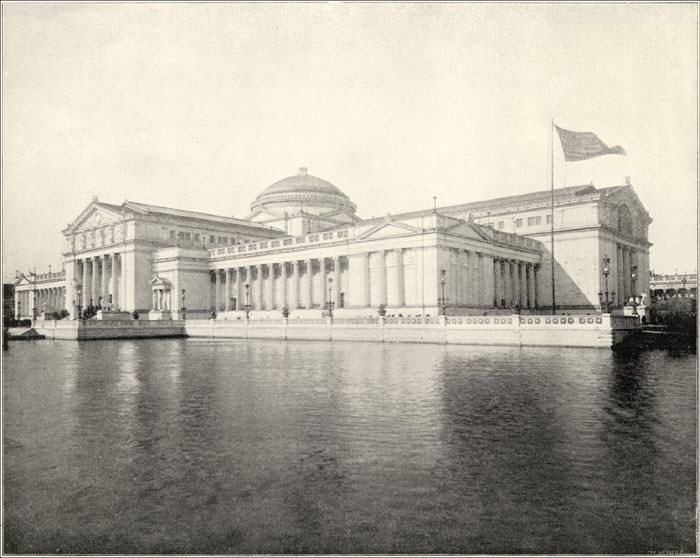
The Palace of Fine Arts across its lagoon in 1893. Built with real masonry so the world’s art could be insured inside it, which is the only reason it could survive to become the Museum of Science and Industry.
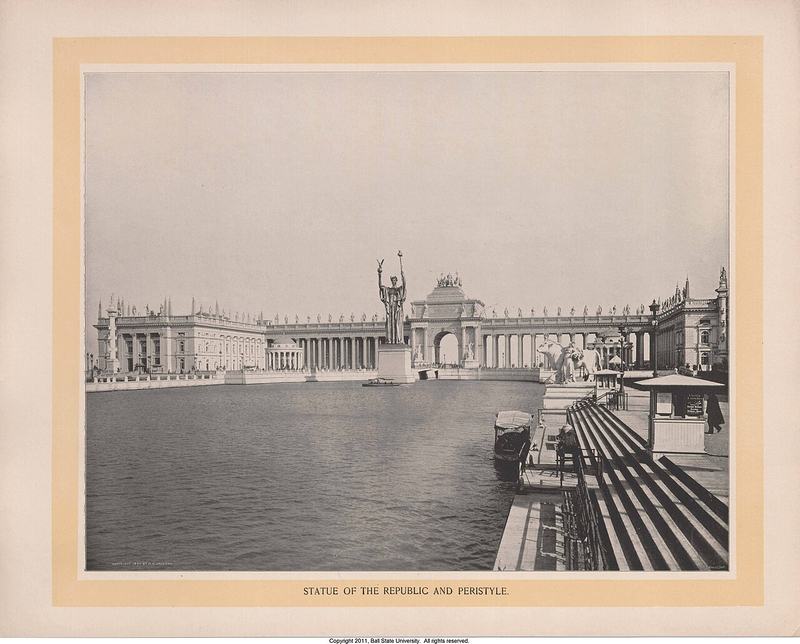
The original sixty-five foot Republic in the Grand Basin. She burned with the rest in 1896; the gilded twenty-four foot Golden Lady standing in Jackson Park today is her 1918 anniversary reduction, by the same sculptor.
The best self-guided tour is simple. Start at the Museum of Science and Industry at 57th Street, the one great building still on its fair footprint, and face the lagoon: you are standing where the North Pond’s crowds queued for gondolas. Cross to the Wooded Island and the Garden of the Phoenix, the quiet Olmsted heart of the grounds, where Japan’s fair pavilion stood for half a century. Walk south along the lagoon to Hayes Drive and the gilded Statue of the Republic, planted almost exactly where the original towered over the Grand Basin. Then walk the Midway Plaisance west, a mile of Olmsted greensward between the university’s gothic walls, and picture the wheel turning over the middle of it. All of it is free, and none of it is a secret, and it is still one of the most remarkable walks in America once you know what you are walking through.
If a client falls for Hyde Park, Woodlawn or South Shore on the strength of that walk, our neighborhood guides pick the story up from there, and the buyer’s guide covers the practical part.