 ← Back to The Boulevard Group
← Back to The Boulevard Group
← Back to The Boulevard Group
Purchase price, the rehab, how long you will hold it, how it is financed and what it sells for: this adds up every cost, including the ones people forget (interest, points, taxes and utilities while you hold it, and the costs of selling), and tells you the profit, the return on your cash, the most you could pay and still hit your number, and how much room you have if the sale price or the rehab budget slips. The 70% rule is in here too, next to the precise version of it.
Built by The Boulevard Group at Fulton Grace Realty, licensed Chicago brokers, with the transfer taxes and fees a Chicago flip pays. Reviewed August 2026.
| Kitchen | |
| Bathrooms (all of them) | |
| Flooring & refinishing | |
| HVAC, water heater, mechanicals | |
| Electrical & plumbing | |
| Roof, windows, exterior, porch | |
| Paint, drywall, trim, doors | |
| Permits, architect, dumpsters, cleaning | |
| Everything else | |
| Contingency (% on top, for surprises) | |
| Rehab budget | $0 |
Interest is paid monthly on what is outstanding. Rehab draws are counted as outstanding for about half the hold on average, since they go out as the work happens.
Left blank, taxes, insurance and utilities are estimated from the price (the estimate shows in the box) so the math never pretends holding is free. Type the real bills when you have them; the tax bill is public on the county site.
Chicago buyers pay a 0.75% city transfer tax; suburban Cook buyers usually pay none (some suburbs have their own). Title, escrow and recording is an estimate if you leave it blank; a title company will quote the real number. A fuller version that pulls each municipality's fees is on the list.
Brokerage compensation is whatever you negotiate; there is no set rate, so both fields start empty. Illinois sellers pay the state and county transfer tax (0.15%); Chicago sellers also pay the CTA portion (0.30%). Owner's title policy and survey are estimated from the price if left blank.
Profit is the sale price minus everything: the purchase price, closing costs and inspection, the rehab budget with its contingency, loan points and fees, interest for every month you hold it, taxes, insurance, utilities and upkeep for those months, and the costs of selling (brokerage, attorney, title, transfer taxes, staging, any credits to the buyer). Return on cash divides that profit by the cash you put in: the down payment, closing costs, the rehab if you fund it yourself, points, and the interest and carrying costs you pay along the way. The annualized figure just restates it as if you could repeat the flip back to back for a year. The 70% rule is the old rule of thumb (pay no more than 70% of the after-repair value, less the rehab); the "to clear your target" number is the precise version for these costs and this financing.
Left out on purpose: income taxes (short-term flips are taxed as ordinary income; talk to your accountant), the value of your own labor and time, and price growth or decline while you hold it. The rehab lines are yours; a real budget comes from a walk-through with a contractor, and Chicago work often needs permits and licensed trades. Everything here is an assumption you should replace with real numbers, and we are glad to help you find them, from the comps that set the after-repair value to the contractors our clients trust.
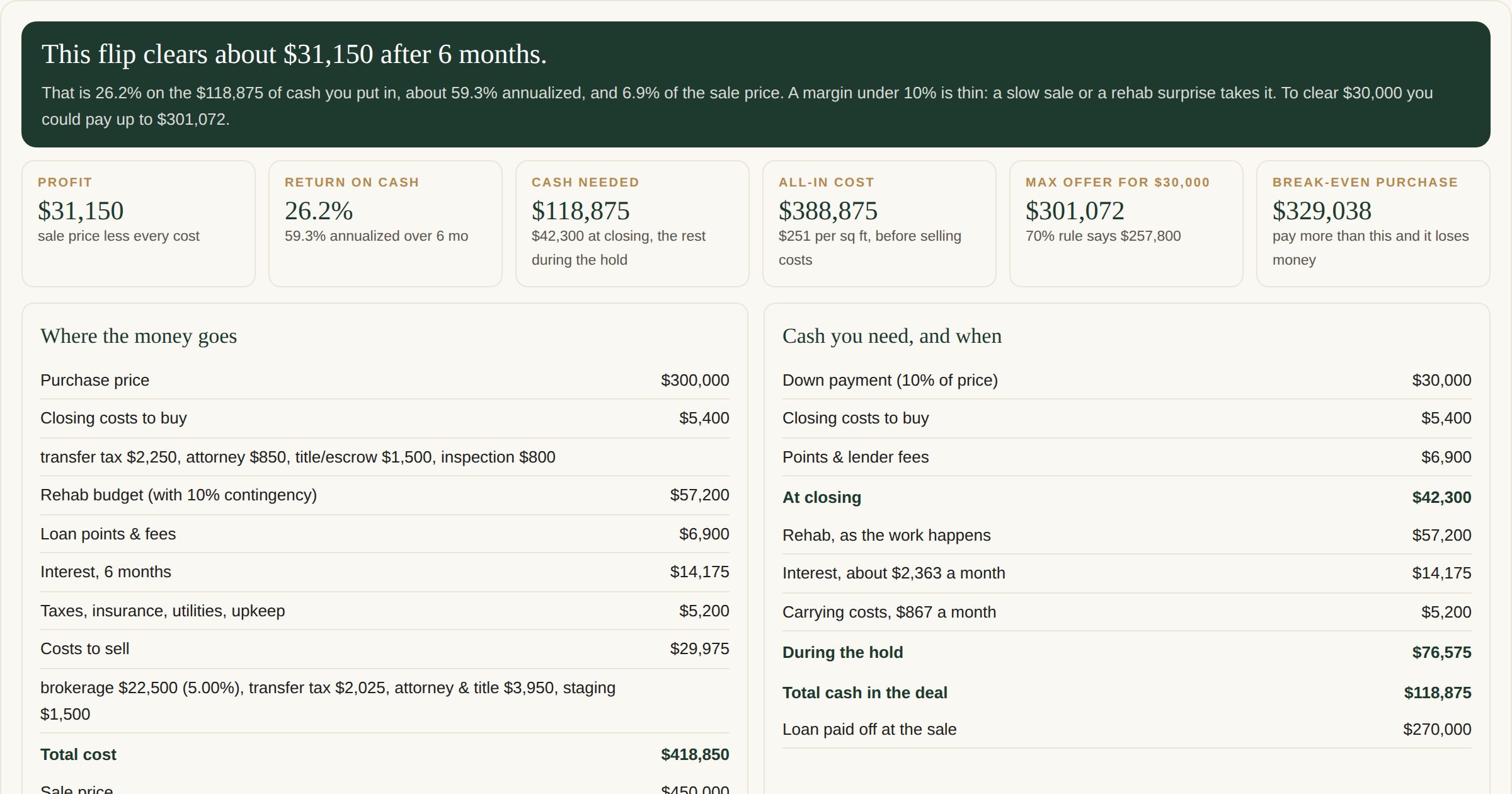
The brick bungalow button up top loads this deal, so here is the whole story in one paragraph. You buy a 1,550 square foot bungalow for $300,000 with a hard money loan covering 90% of the price at 10.5% interest and 2 points, so $30,000 of the price is your cash. The rehab is $52,000 of work plus a 10% contingency, $57,200, paid from your pocket as it happens. You hold it six months: $14,175 of interest, about $5,200 of taxes, insurance and utilities. It sells for $450,000, and selling costs about $29,975 (brokerage as negotiated in the example, seller transfer taxes, attorney, title and staging).
| What it took | |
|---|---|
| Purchase price | $300,000 |
| Closing costs to buy | $5,400 |
| Rehab with contingency | $57,200 |
| Loan points and fees | $6,900 |
| Interest, six months | $14,175 |
| Taxes, insurance, utilities | $5,200 |
| Costs of selling | $29,975 |
| Sold for | $450,000 |
| Profit | $31,150 |
That $31,150 is a 26.2% return on the $118,875 of cash the deal consumed, and 6.9% of the sale price, which is a real but thin margin: the sensitivity table above shows a $22,500 dip in sale price takes most of it. The calculator also answers the question in reverse: to clear $30,000 on this house, the most you could pay is about $301,072, while the old 70% rule would have told you $257,800.
A screening shortcut: pay no more than 70% of the after-repair value, minus the rehab. On a house worth $450,000 fixed up with $57,200 of work, the rule says offer at most $257,800. The missing 30% is meant to cover buying costs, financing, holding, selling and profit all at once, which is why it is a screen and not an answer: cheap money and a fast sale leave room above it, while an expensive loan and a slow winter sale eat it. The max offer figure in this calculator is the precise version, built from your actual costs, financing and profit target.
Beyond the price and the rehab, a Chicago flip pays five stacks of costs. Buying: attorney, title, inspection, and the city transfer tax, where the buyer pays 0.75% of the price. Rehab: the budget plus a contingency, with permits and licensed plumbing and electrical where the work requires them. Financing: points and fees up front, then interest every month. Holding: property taxes, insurance on a vacant house under renovation, utilities and upkeep, times the months you own it. Selling: brokerage compensation (negotiated, there is no set rate), the seller side of transfer taxes (0.15% state and county, plus the 0.30% CTA portion inside Chicago), attorney, title, staging and any buyer credits. The calculator itemizes every one of these lines.
A short-term loan from a private lender, priced on the deal more than the borrower: typically interest-only around 10 to 13%, plus 2 to 3 points up front, covering most of the purchase and often the rehab through draws. Flippers pay those rates for speed and certainty, since hard money closes in days and does not care that the house has no working kitchen. The trade is carry: every extra month is another interest payment, which is exactly what the months field here is for. Our rates guide explains how pricing moves, and the underwriting model covers buildings you keep instead of sell.
After-repair value comes from renovated comparables: recently sold homes of the same type, size and finish level within a few blocks, read per square foot. The mistake that sinks flips is comping a renovated price against unrenovated neighbors, or assuming your finishes will beat the block's ceiling. Type the going renovated price per square foot into the calculator and it will multiply it out for you, then flag when your sale price is optimistic against it. Pulling those comps from the MLS is exactly the kind of thing we do before a client writes an offer.
Almost always, and usually at ordinary income rates, since a property bought to renovate and resell within a year does not get long-term capital gains treatment, and frequent flippers can be treated as dealers, which changes the picture again. None of that is in this calculator on purpose. Talk to an accountant before the first deal, not after, and read the profit here as pre-tax.
The example uses six months from closing to sale, and the drivers are scope, permits, trade schedules, winter and how fast homes in that price band are selling. The way to plan is to price the slip: the last column of the sensitivity table keeps the rehab on budget but adds two months, so you can see what a slow sale costs before you own the slow sale.
Buying, renovating and reselling property you own requires no real estate license in Illinois. The work itself is another matter: Chicago requires permits for most meaningful rehab, plumbing and electrical must be done by licensed trades, and unpermitted work surfaces at resale, when the buyer’s inspector and attorney start asking for the paperwork. Budget the permit line and keep every receipt.
The building stock. This city renovates century-old masonry: brick that needs tuckpointing, not siding, split-face block that needs a moisture check before you buy it, plaster walls that repair differently than drywall, back porches with their own building code, and hundred-year-old systems hiding behind fresh paint. A flipper who can read those buildings, or brings someone who can, prices the rehab right on the first walk-through, and that is the whole game.
We are real estate brokers. We are not lenders, contractors, accountants or investment advisors, and this calculator is an educational model, not a recommendation, a rate quote, a repair estimate or tax advice. Every default is an assumption to be replaced with the property's actual numbers, and every fee in a real transaction is negotiable. Before you make an offer, walk the building with a contractor and an inspector and talk to a lender about the actual terms. We are glad to introduce the ones our clients trust.
We will pull the renovated comps that set the real after-repair value, sanity-check the rehab scope against what buyers in that neighborhood pay for, and run this with the actual numbers. Whether or not you buy it through us, you should know what it clears before you write the offer.
Talk to The Boulevard Group