 All guides & resources →
All guides & resources →
All guides & resources →
The two-flat is Chicago’s signature building: two full apartments stacked under one flat roof, one owner, and a hundred years of families who lived downstairs while the tenant upstairs paid the mortgage. Here is the whole story, when they were built and where, why people bought them then, why people buy them now, and what to look for before you do.
A two-flat is a masonry building holding two complete apartments, one per floor, with a shared front door and staircase, a flat roof draining to the rear behind a parapet, and usually a raised basement below. From the sidewalk it reads as one dignified house: a bay window stacked on a bay window, a face of pressed brick or limestone on the street side, cheaper common brick down the gangway sides where nobody was meant to look. Behind a limestone front the same building is called a greystone; underneath, it is the identical animal. The two-flat’s cousins, the three-flat, the four-flat and the courtyard building, scale the same idea up, and its single-family cousin is the bungalow.
What makes it Chicago’s building is the arithmetic it was born with: the owner lives in one flat and the rent from the other one carries the mortgage. That deal built whole miles of this city, and it still works.
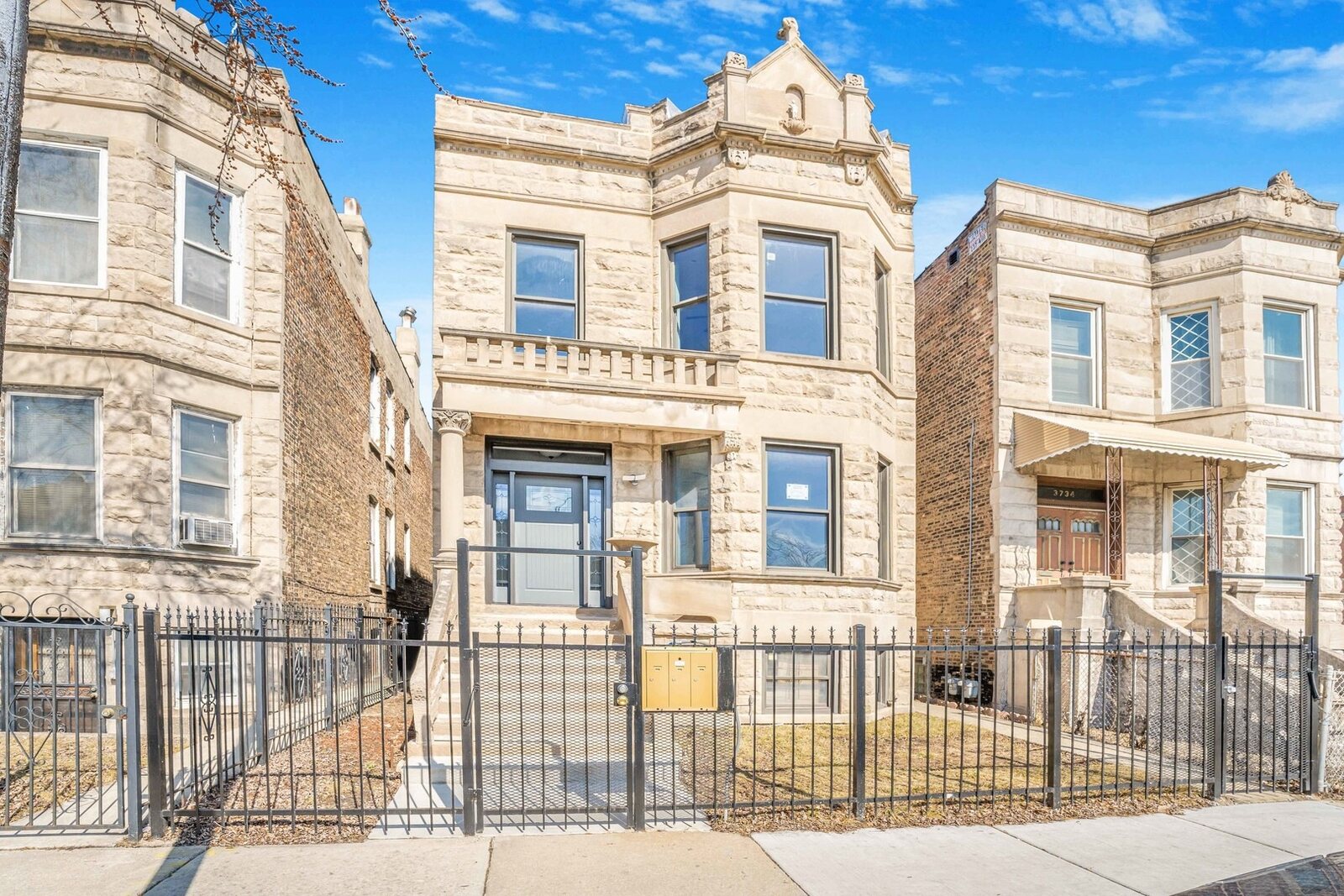
The greystone version, from the first wave: a rough-cut Indiana limestone front over common brick, stacked bays, a carved pediment on the parapet, and the raised entrance over a garden level. The building next door is its near twin, which is how whole blocks went up.
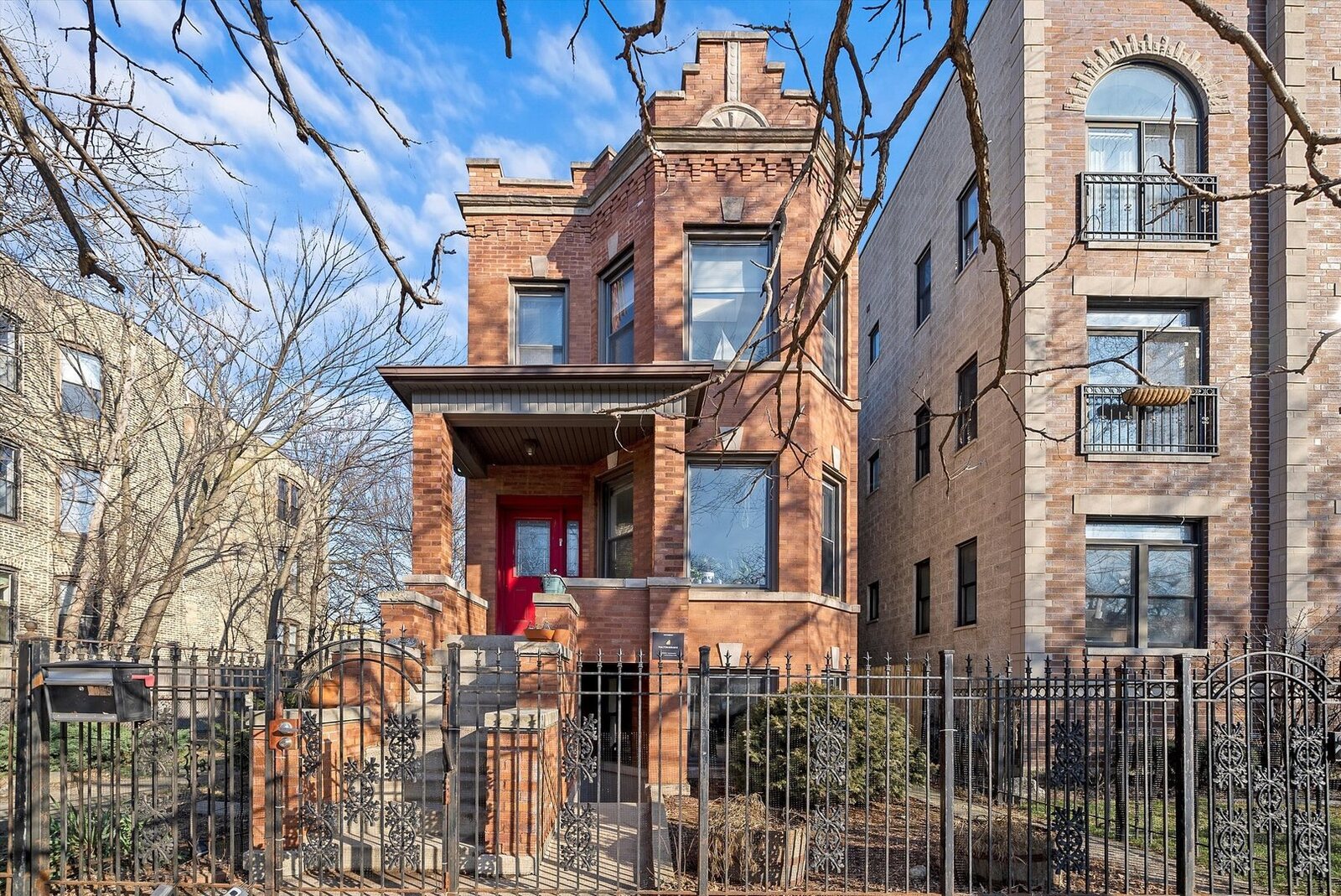
The classic brick version that followed: face brick on the street, a stepped parapet with ornamental brickwork, a proper front porch, and the same stacked bay pouring light into both parlors. Squint past the porch and it is the same machine as the greystone.
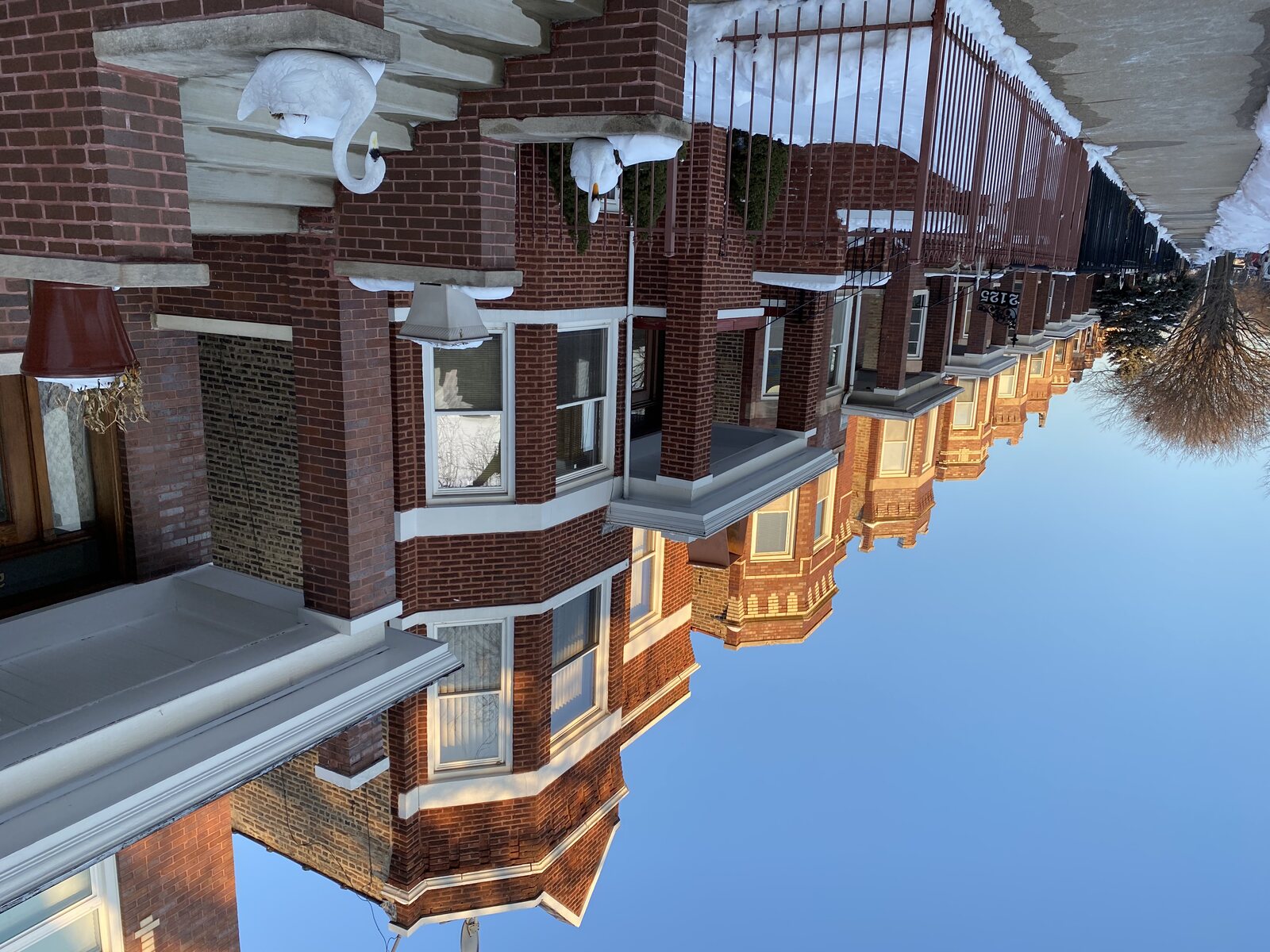
How they actually occur: by the block. The same builders repeated the same plan lot after lot, so the porches, bays and parapets march down the street in rhythm. Look at the side of the nearest building and you can see the whole economics of the type in one glance: pressed face brick on the front where it shows, cheaper common brick down the gangway where it does not.
Every classic two-flat runs on nearly the same plan, which is half the pleasure of touring them. The front parlor takes the bay window and the light; the dining room anchors the middle of the flat; the kitchen sits at the back by the rear porch and its stairs, which double as the second exit; and the bedrooms string down the hall between them. Stack that plan twice, put an unfinished basement with the laundry under the whole footprint, and you have the building.
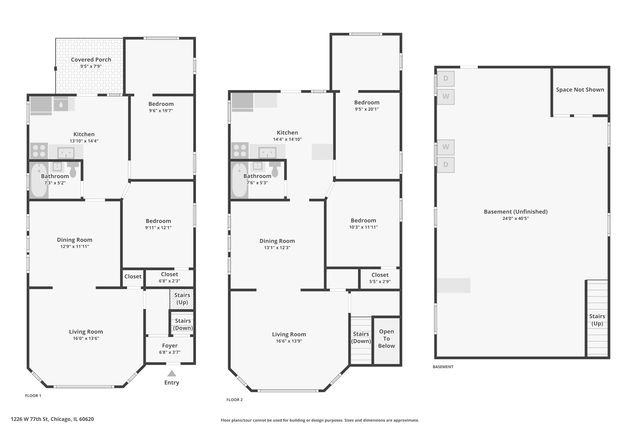
A real two-flat, drawn: first floor, second floor, basement. Notice the floors are near twins, bay to bay and kitchen to kitchen. That stacking is why the plumbing lines up, why renovations stay sane, and why converting between one home and two flats keeps being possible in both directions.
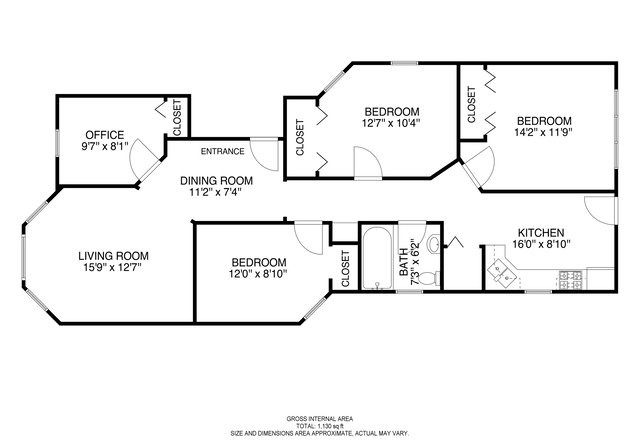
Inside one flat: parlor with the bay up front, dining room behind it, bedrooms off the hall, kitchen at the back. About eleven hundred square feet, which is a genuine three-bedroom apartment, and the reason a two-flat lives so much bigger than its lot suggests.
The two-flat is what happened when three Chicago facts collided. First, the fire: after 1871, and for good after the fire limits spread, the city that rebuilt was a masonry city, and brick construction pushed builders toward compact, repeatable buildings on the standard twenty-five foot lot. Second, the boom: between 1880 and 1930 Chicago roughly tripled, from about half a million people past three million, the fastest sustained growth any American city had seen, and all of those people needed homes near the streetcar and elevated lines that were shooting outward. Third, the ladder: the city filled with working families, many of them immigrants, who wanted to own property but could not carry a whole mortgage on one wage.
The two-flat answered all three at once. A family bought the building, lived on one floor, and let the other floor’s rent carry the loan; the tenant was often a relative, a countryman, or the in-laws. Neighborhood building and loan associations, many organized around a parish or a language, Bohemian, Polish, Lithuanian, Italian, German, financed them by the block, which is why whole miles of the Northwest and Southwest sides went up in near-identical brick. Contemporaries called those associations the working family’s bank, and the two-flat was the thing they were built to buy. It was never a compromise on the way to a house; for two generations it WAS the house, with an income attached.
The building itself evolved in plain sight. The 1890s versions wear limestone fronts, the greystones, with tall parlor windows and carved detail. By the 1910s the classic pressed-brick front with stacked bays took over, and by the 1920s the fronts flattened into handsome tapestry brick with sunrooms across the front instead of open bays. Then 1929 turned the lights off. Very few two-flats were built after the Depression began; the stock you tour today is almost all between ninety and a hundred and thirty years old.
You can read the construction date off the map, because the two-flats followed the transit lines outward in rings.
The 1890s and 1900s, the greystone ring. The first great wave went up close to the core and along the boulevards: North Lawndale and Douglas Park, Bronzeville and the Grand Boulevard corridor, Wicker Park and West Town, Lakeview and Lincoln Park’s side streets. Bronzeville’s greystone blocks and Lawndale’s Douglas Boulevard frontage are the most intact stretches of this era, and during the Great Migration those solid buildings became the housing backbone of the city’s Black South and West sides.
The 1900s and 1910s, the streetcar miles. The classic brick two-flat filled the miles the streetcars opened: Logan Square, Avondale and Hermosa on the Northwest Side; Pilsen, McKinley Park, Brighton Park and Back of the Yards on the Southwest, where packinghouse and factory wages bought them; Albany Park and Irving Park as the Ravenswood elevated arrived; Woodlawn and South Shore as the South Side lines and the fair-era boom filled in.
The 1920s, the last and fanciest ring. The final wave, sunroom-fronted and tapestry-bricked, reached Belmont Cragin, Portage Park and Jefferson Park, Gage Park and Chicago Lawn, Rogers Park and West Ridge, and jumped the city line into Berwyn and Cicero, which today hold some of the most uniform two-flat blocks anywhere. When people say a neighborhood “feels like Chicago,” nine times out of ten they are describing one of these rings.
Three forces have been quietly subtracting two-flats for decades. The Depression stopped construction and the postwar decades never restarted it; federal lending and the expressways pointed the next generation of buyers at new single-family houses instead, in the bungalow belt and the suburbs. In strong markets the buildings themselves get deconverted, joined back into big single-family homes, which is why Lincoln Park and Bucktown side streets hold two-flat shells living as mansions. And in the neighborhoods hit hardest by disinvestment, buildings were lost outright to decline and demolition. Housing researchers at DePaul’s Institute for Housing Studies have tracked the shrinking of the two-to-four-flat stock for years, and the city now actively encourages keeping and adding units, including the ordinance that re-legalized accessory dwelling units in parts of the city in 2021. The two-flat went from workhorse to endangered species to policy darling in one century, and none of that changed what it is: the most practical building this city ever produced.
A two-flat makes the most sense for an owner-occupant who wants help carrying the payment and is comfortable being one household’s property owner. The century-old logic still runs: you live in one flat, the other flat’s rent offsets your mortgage, and lenders will often count part of that expected rent when qualifying you, which means many buyers can reach a two-flat with a down payment in the same neighborhood as a house’s. Later, the building flexes: parents downstairs, a grown kid upstairs, or two rentals if you move on and keep it.
The other side of the ledger is just as real. You are buying a roughly hundred-year-old masonry building, so you are also buying its maintenance schedule: tuckpointing, parapets, porches, boilers. You are signing up for tenant responsibilities under Chicago’s landlord-tenant ordinance, which is specific about deposits, notices and repairs, and vacancy months are yours to carry. And the neighborhoods where the rent math is strongest are not always the neighborhoods where appreciation has been strongest, so a two-flat is a cash-flow decision and a location decision at the same time.
Our rent vs. buy calculator compares renting against owning with Chicago costs in it. Point it at a two-flat by entering your share of the payment after the other unit’s rent, and you will see quickly whether the building carries itself.
This page is general information, not financial or legal advice; the real answer comes from your own numbers. Run them in the calculator above, read the buyer’s guide for the process, and when you want lender introductions or a walk through actual buildings, that is what we do all day.
Every two-flat tour is really an inspection of five systems. The full checklist lives in Buying an Old Home in Chicago, but these are the ones that write the checks:
We keep referral partners for exactly these buildings, the inspectors, masons and porch carpenters the team actually uses; ask and we will send you the right ones for a two-flat.
It depends on whether you want a tenant. A two-flat gives an owner-occupant rental income that offsets the mortgage and a second unit for future family use, in exchange for maintenance duty and tenant responsibilities that a condo or single-family home never asks of you. Run your own numbers with our rent vs. buy calculator and talk to a lender before deciding; this page explains the trade-offs but is general information, not financial advice.
Yes. Living in one flat and renting the other is the arrangement the buildings were designed for in the early 1900s, and it is still the most common way owner-occupants buy them. Lenders treat an owner-occupied two-flat much like a house, and many will count part of the expected rent when qualifying you.
Owner-occupants can typically finance a two- to four-unit building with low down payment programs similar to those for single-family homes, while investors who will not live in the building usually need substantially more down. Programs and limits change, so the current answer comes from a lender conversation; we are glad to make the introduction.
Masonry, roof, porches, plumbing and electrical, heating and metering, and the legality of any basement unit, in that order of expense. The section above walks each one, and Buying an Old Home in Chicago goes deeper.
Turning a two-flat back into one large single-family home. Common where big houses are scarce and expensive, and one reason the city’s two-to-four-flat stock keeps shrinking; whether it adds value is block-by-block math.
Where the two-flat sits among its relatives, greystones, bungalows, courtyard buildings and the rest, is the subject of our Chicago home styles guide. And if you want the era that built the city that built the two-flat, start with the 1893 World’s Fair.