All guides & resources →
Explore Chicago

The buildings that make the Chicago skyline

Chicago invented the skyscraper and never stopped. Here are the towers you will point at from the lake, the river and the L, with the stories behind them, and a straight answer to the question every visitor asks: can I go up?

The tall ones·The classics you will walk past·Five more·Two footnotesAll resources →

How to read the skyline in three eras

1880s to 1890s, the Chicago School. After the 1871 fire the city rebuilt with iron and steel frames, big windows and little fuss: the Rookery, the Monadnock, the demolished Home Insurance Building. Squat by today's standards, radical for theirs.

1920s to 1930s, the crowns. Money and a new zoning law that rewarded setbacks gave us the Gothic Tribune Tower, the white Wrigley Building, the Art Deco Board of Trade and Carbide & Carbon, and the vast Merchandise Mart. Look up: this is the era of ornament.

1950s onward, glass, steel and concrete. Mies van der Rohe's 860-880 Lake Shore Drive set the template, Bertrand Goldberg poured Marina City, and SOM engineer Fazlur Khan figured out how to go past 100 stories with the Hancock and the Sears (now Willis) Tower. The newest chapter belongs to Studio Gang, whose Aqua and St. Regis ripple instead of stepping.

Where to look from. The Riverwalk and the Chicago Architecture Center's river cruise for the downtown canyon; the Adler Planetarium terrace or the Museum Campus for the classic postcard; Ohio Street Beach and North Avenue Beach for the Hancock side; and the CTA Brown Line loop for the cheapest architecture tour in America. New here? Our Chicagoland for newcomers page explains the grid you will be looking down on.

The tall ones

The towers that make the postcard: how each one stands up, and what you can go inside.

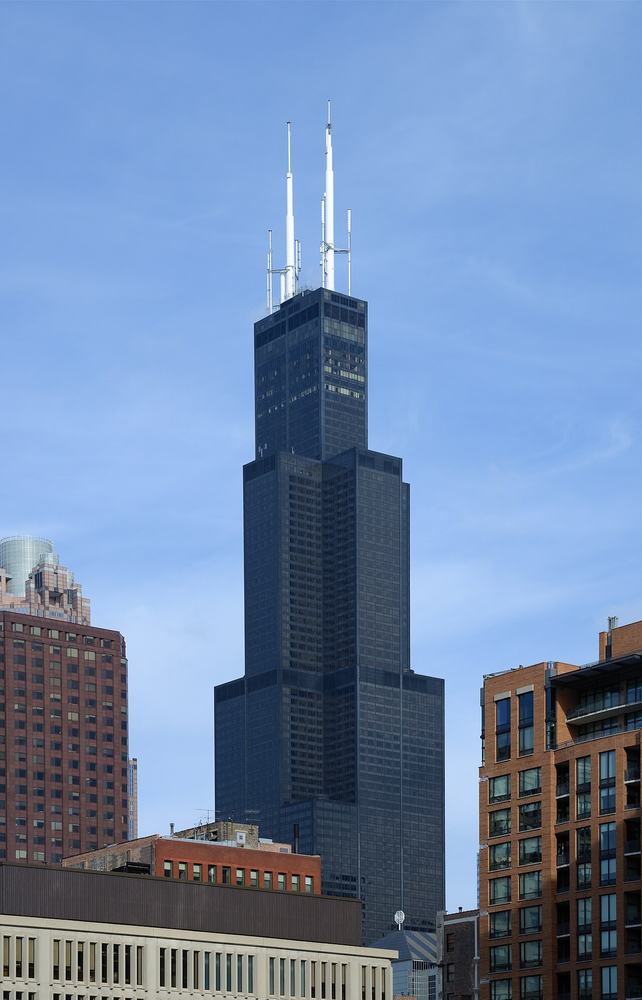
Willis Tower rising above the Loop, black aluminum and bronze glass
Photo: Alvesgaspar, CC BY-SA 4.0
1973·Sears Tower until 2009·SOM: Bruce Graham with engineer Fazlur Khan·1,451 ft, 110 stories·233 S. Wacker Dr.

Willis Tower (the Sears Tower)

Sears, Roebuck built it as the Sears Tower, its headquarters, in 1973, and it held the title of tallest building in the world for 25 years. It is still the tallest in Chicago, and to most of the city it is still the Sears Tower. The trick is Fazlur Khan's bundled tube: nine square steel tubes, each 75 feet on a side, that stop at different heights (you can see the setbacks at floors 50, 66 and 90). The idea later showed up in supertalls all over the world, including the Burj Khalifa. Sears moved out in the 1990s, the naming rights went to the London insurance broker Willis Group in 2009 (hence the name almost nobody uses), and Blackstone finished a big renovation in 2022 that added Catalog, a five-level shopping and dining base with a public rooftop terrace.
Go: Skydeck Chicago on the 103rd floor, with The Ledge glass boxes that hang about four feet out from the wall; Catalog and its terrace are free to wander.
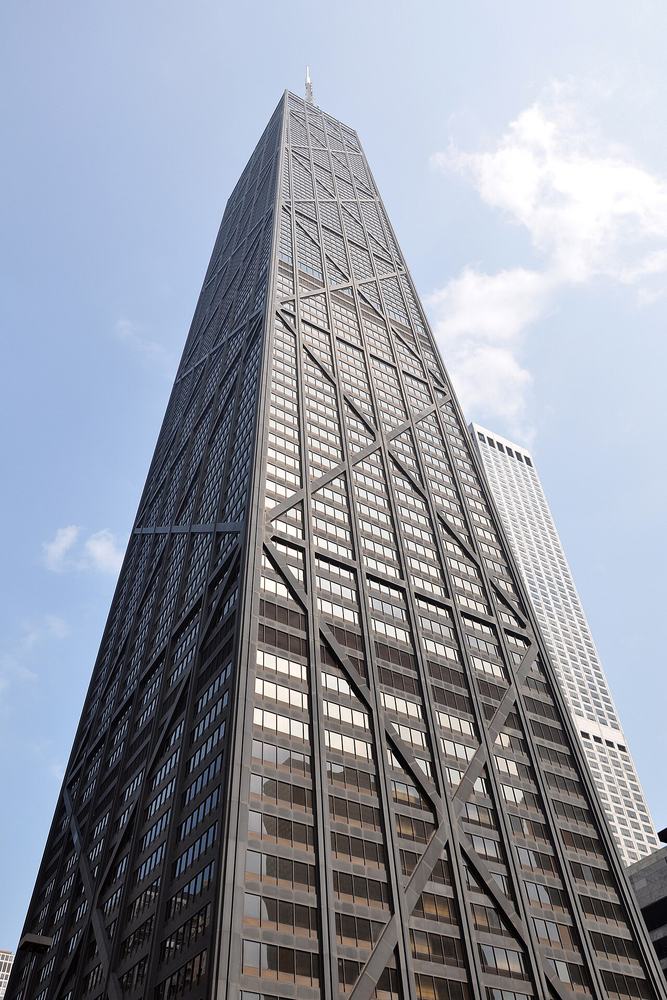
The tapering black tower of 875 North Michigan with its giant exterior X-braces
Photo: Joe Ravi, CC BY-SA 3.0
1969·SOM: Bruce Graham and Fazlur Khan·1,128 ft, 100 stories·875 N. Michigan Ave.

875 North Michigan Avenue (the John Hancock Center)

Everyone still calls it the Hancock. The insurance company asked for its name to come off in 2018, so the official name is now the address. The giant X-braces on the outside are not decoration; they are the structure, a trussed tube that lets the tapering tower fight the wind with far less steel than a normal frame. It was also one of the first true mixed-use skyscrapers: offices and parking below, about 700 condos on floors 44 to 92, and a sky lobby with an indoor pool on 44. Locals will tell you the view here beats the Willis Tower's because you can see the Willis Tower in it.

Go: 360 CHICAGO on the 94th floor, with TILT, a glass bay that tips you outward; the deck is expanding into the old Signature Room floors above.
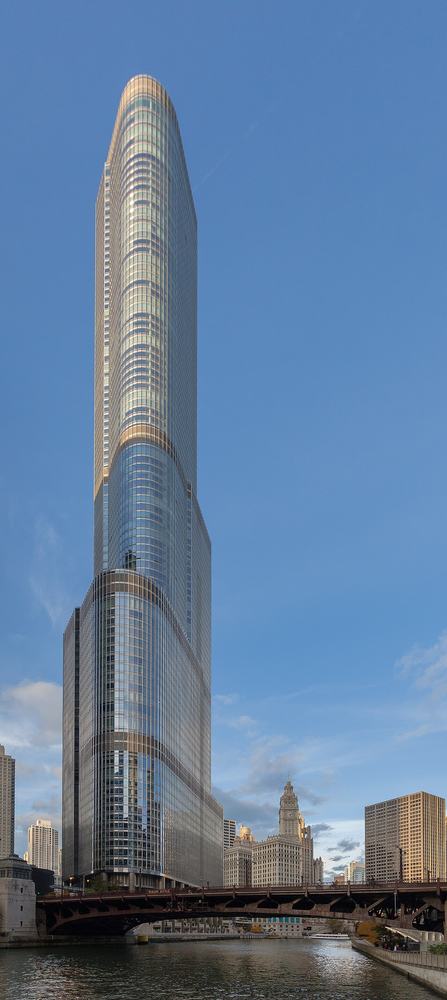
The glass Trump International Hotel and Tower on the Chicago River
Photo: Diego Delso, delso.photo, CC BY-SA 3.0
2009·SOM: Adrian Smith·1,388 ft with spire, 98 floors·401 N. Wabash Ave.

Trump International Hotel & Tower

The second-tallest building in the city sits on the river where the old Sun-Times building used to be. Adrian Smith, who went on to design the Burj Khalifa, set the tower's three setbacks to line up with the heights of its neighbors: the Wrigley Building, River Plaza and Marina City. Whatever you think of the 20-foot letters that went up on the river side in 2014, the building itself is a hotel, condominiums, restaurants and a riverfront plaza, and it reads best from the Riverwalk or the Wabash bridge.

Go: Hotel, restaurants and the riverfront plaza are open to the public; there is no observation deck.
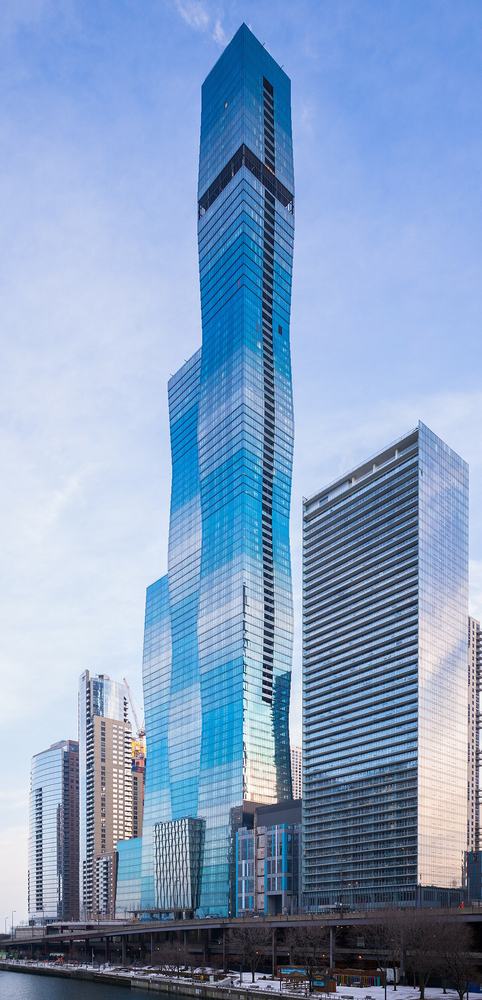
The three stepped blue-green stems of the St. Regis Chicago tower
Photo: R Boed, CC BY 2.0
2020·Studio Gang: Jeanne Gang·1,191 ft, 101 stories·363 and 401 E. Wacker Dr.

St. Regis Chicago (Vista Tower)

The newest of the giants and the tallest building in the world designed by a woman-led firm. Jeanne Gang's tower is really three connected stems of 47, 71 and 93 stories, each stacked from 12-story truncated pyramids that flip orientation as they climb, which is what makes the wavy profile without a single piece of curved glass. The skin uses six shades of blue-green glass. Near the top there is an open blow-through floor that lets the wind pass so the building sways less. It was called Vista Tower until 2020, when the hotel deal was signed; the St. Regis opened in 2023 above 393 condominiums.

Go: Hotel restaurants and bar are open to the public; residences are private; no observation deck.
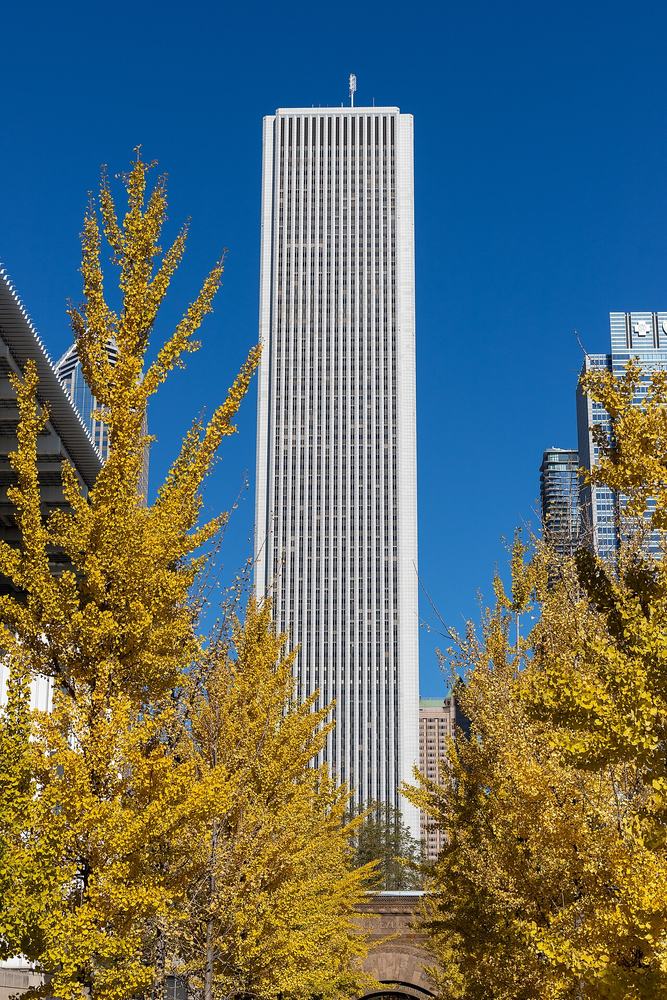
The white granite Aon Center standing over Millennium Park
Photo: Paul R. Burley, CC BY-SA 4.0
1973·Edward Durell Stone with Perkins & Will·1,136 ft, 83 stories·200 E. Randolph St.

Aon Center

Big Stan, as it was nicknamed when it opened as the Standard Oil Building, is the plain white tower behind Millennium Park. Its claim to fame is a cautionary tale: it was clad in about 43,000 thin slabs of Italian Carrara marble, the tallest marble building anywhere, and the slabs bowed and cracked in Chicago weather. One fell the year it opened. The whole tower was reclad in North Carolina granite in the early 1990s at a cost north of $80 million. An observation deck with an outside glass elevator was announced in 2018 and never built, so this one is for looking at, not looking out from.

Go: Office lobby and plaza only; best seen from Millennium Park.
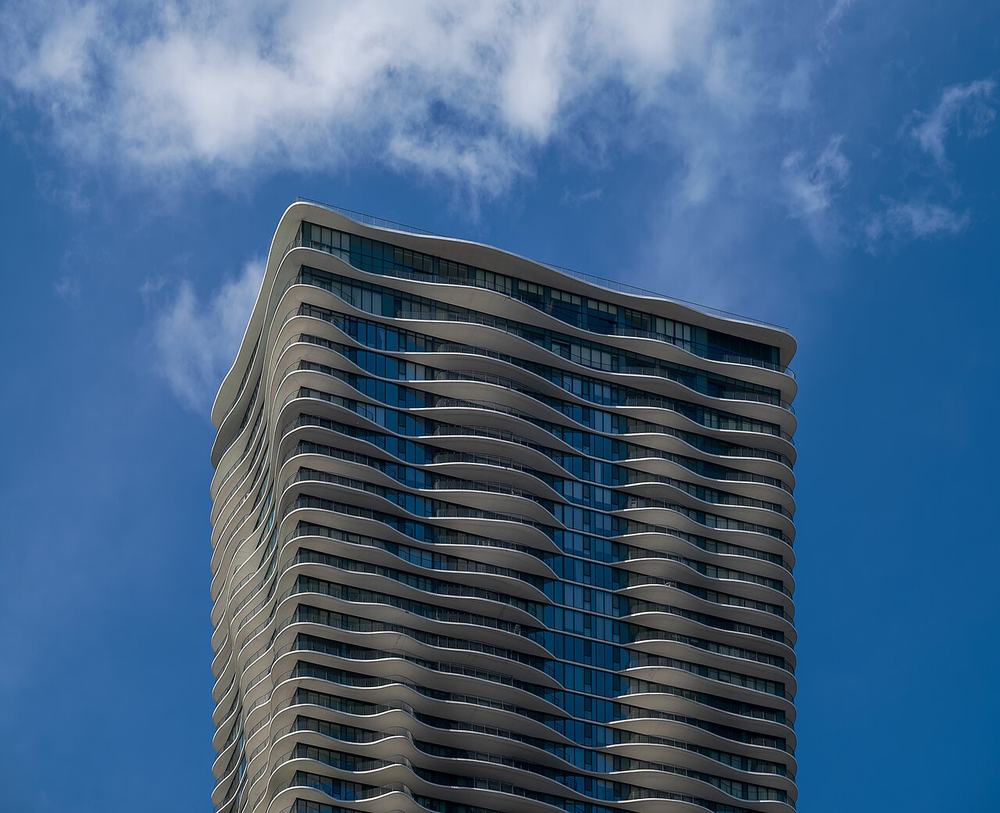
The rippling white balconies of the Aqua tower
Photo: Jules Verne Times Two, CC BY-SA 4.0
2009·Studio Gang: Jeanne Gang·859 ft, 82 stories·225 N. Columbus Dr.

Aqua

The building that made Studio Gang famous. Every floor slab is a slightly different shape, so the balconies ripple in and out by anywhere from two to twelve feet. That is not just for looks: the shapes were tuned to grab views of specific landmarks, shade the glass in summer and break up the wind, and Gang has said the limestone outcroppings along the Great Lakes were the inspiration. Hotel on the lower floors, apartments above, condos at the top, and one of the biggest green roofs in the city on the podium. When it opened it was the tallest building in the world designed by a woman-led firm, a title it handed to its taller sibling, the St. Regis, in 2020.

Go: Hotel guests only inside; look at it from Lakeshore East Park or Columbus Drive.
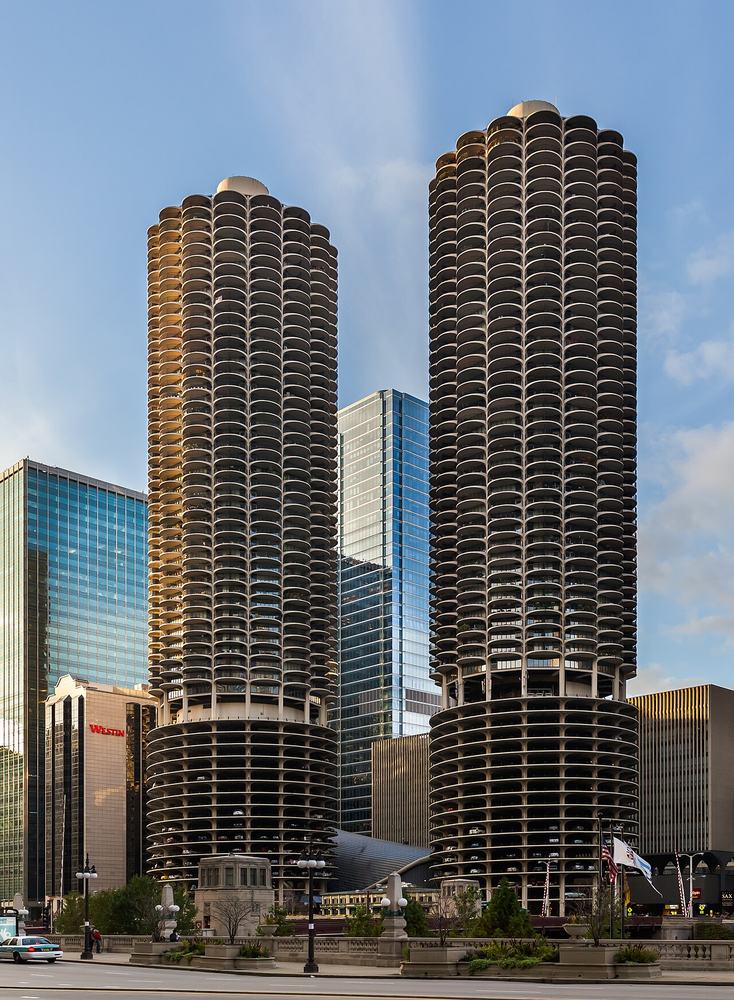
The two round concrete corncob towers of Marina City on the river
Photo: Diego Delso, delso.photo, CC BY-SA 3.0
1961 to 1968·Bertrand Goldberg·587 ft, 65 stories each·300 N. State St.

Marina City

The corncobs. Two round concrete towers that were, when they opened, the tallest residential buildings and the tallest reinforced-concrete structures in the world. The bottom nineteen or so floors of each are an open spiral parking ramp, which is how a car ends up in the river in the 1980 Steve McQueen movie The Hunter. Above that the apartments are pie slices with no interior right angles and a balcony off every room. It was financed by a janitors' union as a city within a city, with a marina, a theater, a bowling alley and an ice rink, meant to keep people from fleeing to the suburbs. It worked. The towers went condo in 1977, became a Chicago Landmark in 2016, and you know them from the cover of Wilco's Yankee Hotel Foxtrot.

Go: House of Blues, the hotel, the bowling alley and restaurants are open to all; the towers themselves are private. Best view is from the Riverwalk.
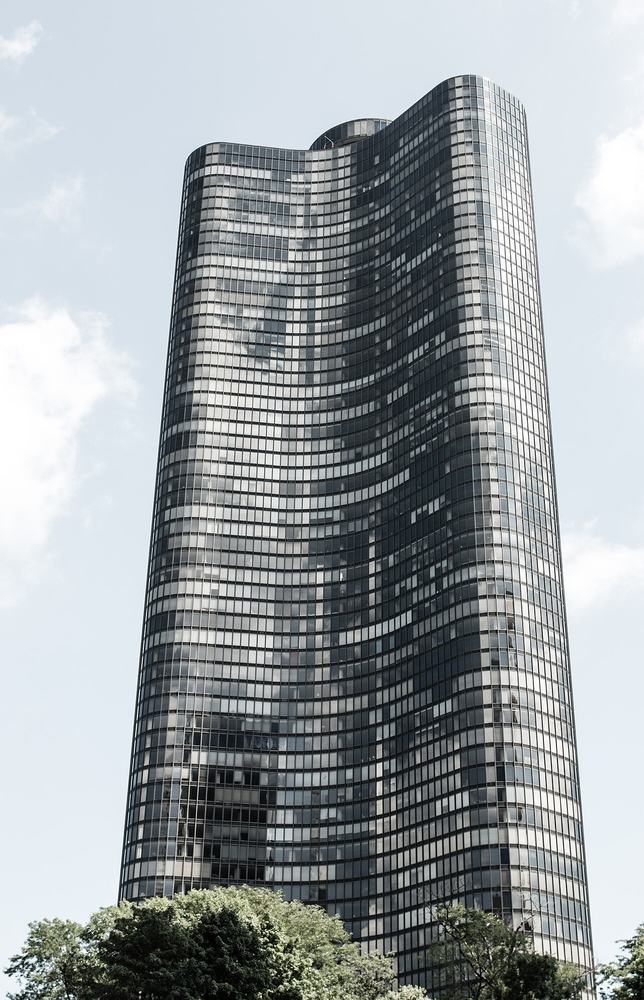
The curved dark glass of Lake Point Tower beside Navy Pier
Photo: Sharon Mollerus, CC BY 2.0
1968·Schipporeit-Heinrich·645 ft, 70 stories·505 N. Lake Shore Dr.

Lake Point Tower

The lone tower on the lake side of Lake Shore Drive, next to Navy Pier. Two students of Mies van der Rohe built the glass skyscraper their teacher had only drawn in 1922: a three-lobed clover plan around a triangular core, wrapped in curved bronze glass. It was the tallest apartment building in the world when it opened. It is the only skyscraper east of the Drive downtown, though that is partly an accident of the Drive being rerouted in the 1980s. On the roof of the podium sits a private two-and-a-half-acre park with a lagoon and a waterfall by Alfred Caldwell, the same landscape architect behind the Lily Pool in Lincoln Park.

Go: Private residences, no public access; admire it from Ohio Street Beach, Navy Pier or the Lakefront Trail.
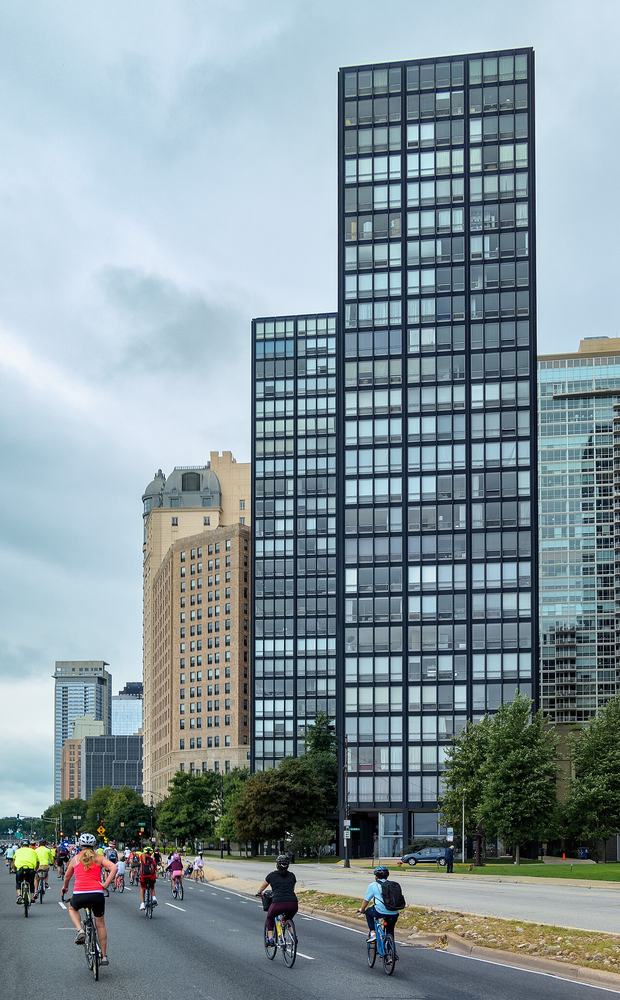
The twin black steel and glass towers of 860 and 880 Lake Shore Drive
Photo: Kenneth C. Zirkel, CC BY-SA 4.0
1951·Ludwig Mies van der Rohe·254 ft, 26 stories each·860 to 880 N. Lake Shore Dr.

860 and 880 Lake Shore Drive

Not tall by today's standards, but these two are the reason half the glass boxes on earth look the way they do. Mies van der Rohe set two identical steel-and-glass towers at right angles on a lakefront lot so every apartment gets water views, and welded non-structural steel I-beams to the outside as mullions to express the structure inside. Floor-to-ceiling glass on a 21-foot column grid, all painted black. Life magazine called them masterpieces in 1957 and they were the first Mies buildings named Chicago Landmarks. Once you have seen them you will spot their children everywhere from here to Hong Kong.

Go: Private residences; the plaza and the facades are best from Lake Shore Drive, the Lakefront Trail or Oak Street Beach.

The classics you will walk past

Older, shorter, and in some ways more Chicago: the 1880s to 1930s buildings that taught the world how to build tall.

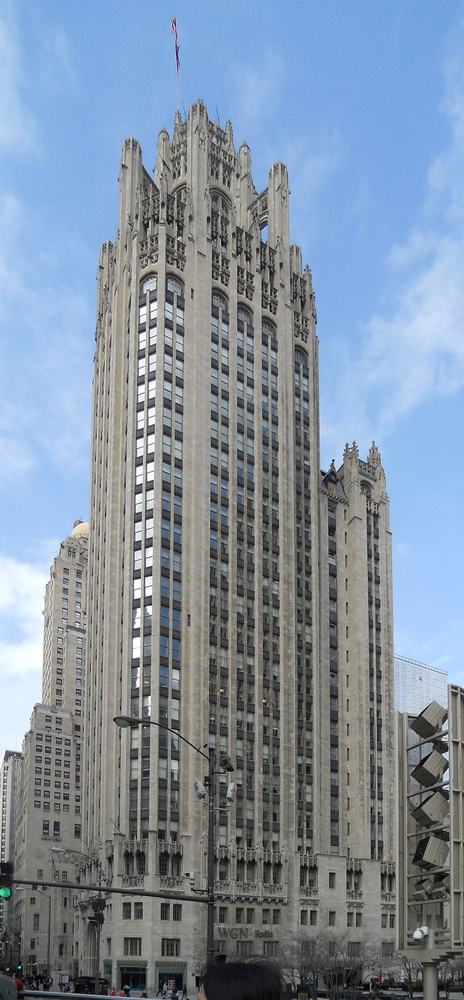
The Gothic crown of Tribune Tower with its flying buttresses
Photo: Potro, CC BY-SA 4.0
1925·Howells & Hood·462 ft, 36 stories·435 N. Michigan Ave.

Tribune Tower

In 1922 the Chicago Tribune ran an international competition for the most beautiful office building in the world and got more than 260 entries. The Gothic winner has a crown of flying buttresses borrowed from the Butter Tower of Rouen Cathedral. The thing to do at street level is walk the base slowly: roughly 150 stones and fragments from famous places are set into the walls, labeled, including bits of the Great Wall, the Parthenon, the Taj Mahal, the Great Pyramid and steel from the World Trade Center. The newspaper moved out in 2018 and the tower is now 162 condominiums, a conversion good enough to win a national adaptive-reuse prize.

Go: Private residences, but the stone collection is on the public sidewalks along Michigan Avenue and Illinois Street.
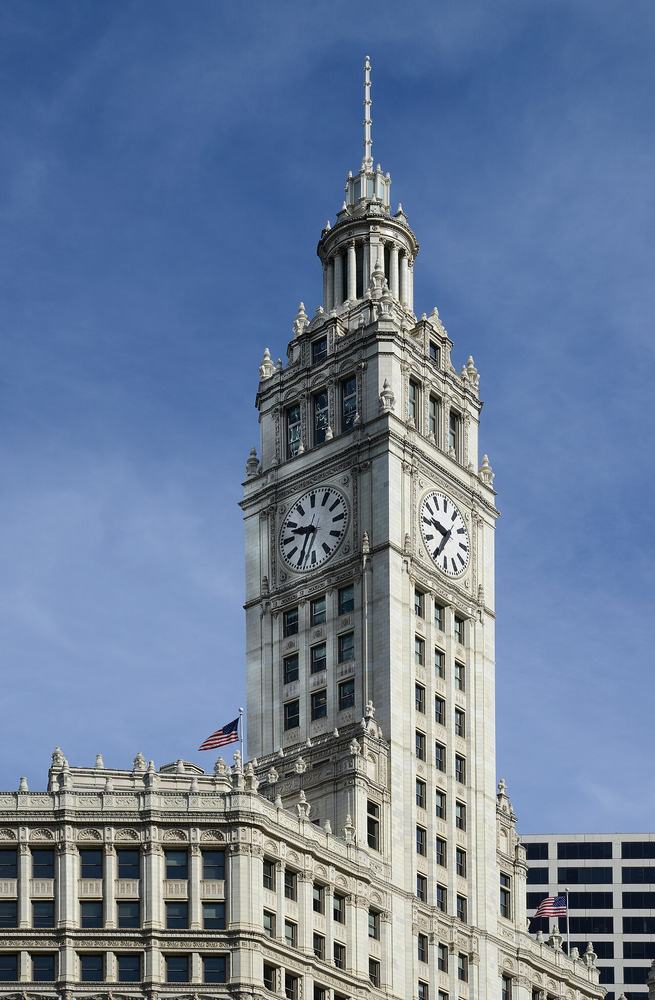
The white terra cotta clock tower of the Wrigley Building lit at dusk
Photo: Alvesgaspar, CC BY-SA 4.0
1921 and 1924·Graham, Anderson, Probst & White·425 ft·400 to 410 N. Michigan Ave.

Wrigley Building

The chewing gum company's headquarters was the first big office building north of the river once Michigan Avenue was extended across it, and it set the tone for everything that followed. The clock tower is a copy of the Giralda in Seville with faces almost 20 feet across. The terra cotta comes in six graduated shades of white that get brighter toward the top so the building seems to glow, and it has been floodlit at night since it opened, with only three interruptions in a century (a world war, a relamping and the 1970s energy crisis). It is also, by the Chicago Architecture Center's telling, the city's first air-conditioned office building.

Go: Working offices; the plaza and river walkways are public and it is best from the Michigan Avenue bridge or the Riverwalk.
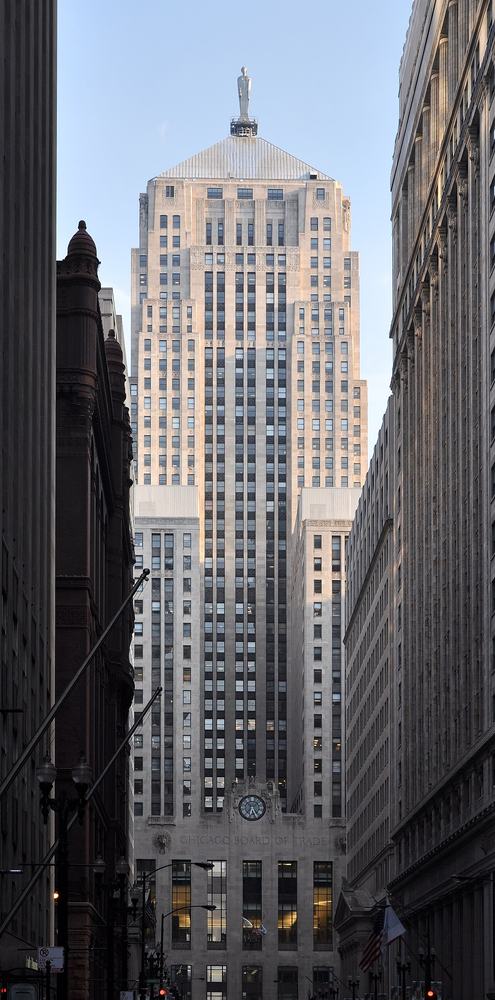
The Art Deco Chicago Board of Trade Building closing the view down LaSalle Street
Photo: Joe Ravi, CC BY-SA 3.0
1930·Holabird & Root·605 ft, 44 stories·141 W. Jackson Blvd.

Chicago Board of Trade Building

Stand anywhere on LaSalle Street and look south: the canyon ends at this Art Deco tower, which was the tallest building in Chicago from 1930 until 1965. Over the door a 13-foot clock is flanked by hooded figures holding grain and corn. On the roof stands a 31-foot aluminum statue of Ceres, the Roman goddess of grain, and she has no face, because the sculptor figured nobody would ever be high enough to see it. If the building looks familiar it played Wayne Enterprises in the Batman movies. The trading floors that made it famous have moved on; new owners have re-leased it as offices, and the lobby is worth a look through the Jackson Boulevard doors.

Go: Office building; peek at the restored lobby from the Jackson entrance and photograph it from LaSalle Street.
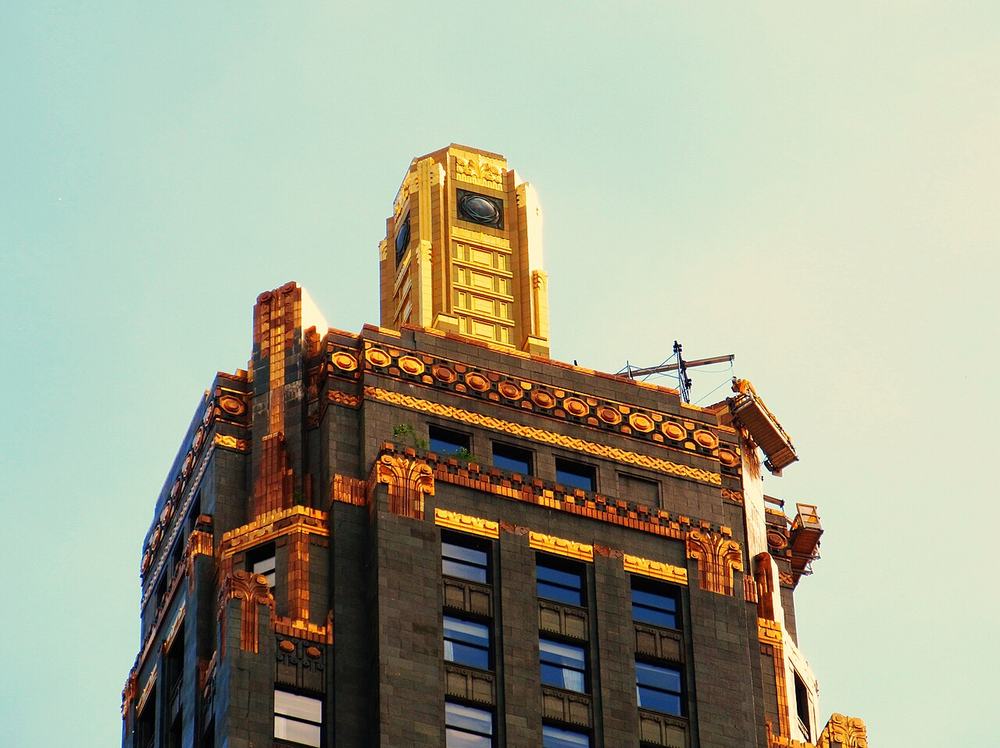
The dark green terra cotta and gold top of the Carbide and Carbon Building
Photo: Ken Lund, CC BY-SA 2.0
1929·Burnham Brothers·503 ft, 37 stories·230 N. Michigan Ave.

Carbide & Carbon Building

Daniel Burnham's sons designed this one, and the story everyone tells is that it is meant to look like a bottle of champagne: polished black granite at the base, dark green terra cotta up the shaft and real gold leaf on the top. Nobody has proven that was the intent, and nobody has stopped repeating it. The gilded crown has been lit at night since 2007. It has been a hotel since 2004 under a series of names and today is the Pendry Chicago, which means the Art Deco lobby, with its Belgian marble and bronze, is open to anyone who walks in for a drink.

Go: Pendry Chicago hotel: lobby, restaurants and the rooftop bar are open to the public.
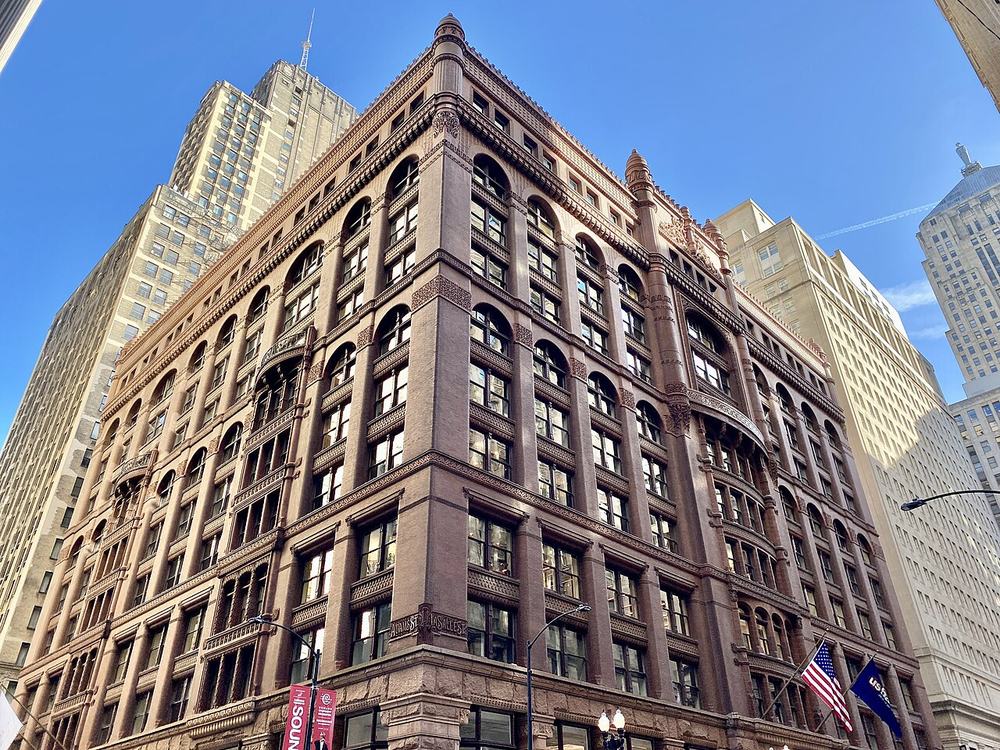
The Rookery Building at LaSalle and Adams
Photo: w_lemay, CC BY-SA 2.0
1888·Burnham & Root; light court by Frank Lloyd Wright, 1905·181 ft, 12 stories·209 S. LaSalle St.

The Rookery

One of the oldest high-rises still standing in the city and one of the best interiors in it. Burnham and Root built it in 1888 as a hybrid: load-bearing masonry outside, an iron and steel frame inside, sitting on Root's floating grillage foundation of iron rails in concrete because Chicago's soil is mud. In 1905 Frank Lloyd Wright remodeled the skylit central light court, wrapping Root's ironwork in white marble incised with gold. The name is a joke: after the 1871 fire the temporary City Hall on this site was overrun with pigeons and, some said, with political rooks. Carved rooks flank the LaSalle Street entrance to this day.

Go: The light court is open on weekdays and the Frank Lloyd Wright Trust runs short weekday tours from its shop inside.
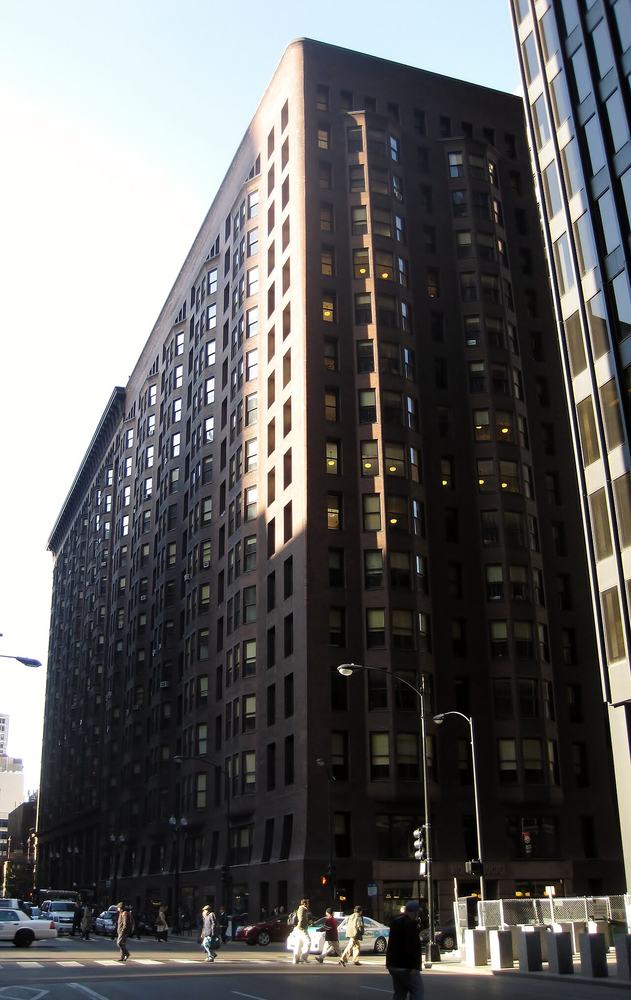
The dark unornamented brick walls of the Monadnock Building
Photo: Teemu008, CC BY-SA 2.0
1891 and 1893·Burnham & Root (north); Holabird & Roche (south)·about 215 ft, 16 stories·53 W. Jackson Blvd.

Monadnock Building

Two eras of skyscraper stand shoulder to shoulder in one block. The north half, by John Root, is the tallest commercial building ever held up by brick walls alone: six feet thick at the sidewalk, tapering to 18 inches at the top, with a flared base and curved cornice that recall an Egyptian papyrus column and no ornament at all, at the owners' insistence. Two years later the south half went up on a steel frame with a classical face. The stairs inside are credited as the first architectural use of aluminum in a building. The ground-floor arcade, restored over a decade by a devoted owner, is one of the nicest places downtown to buy a hat or a coffee.

Go: Ground-floor arcade and lobby open during business hours.
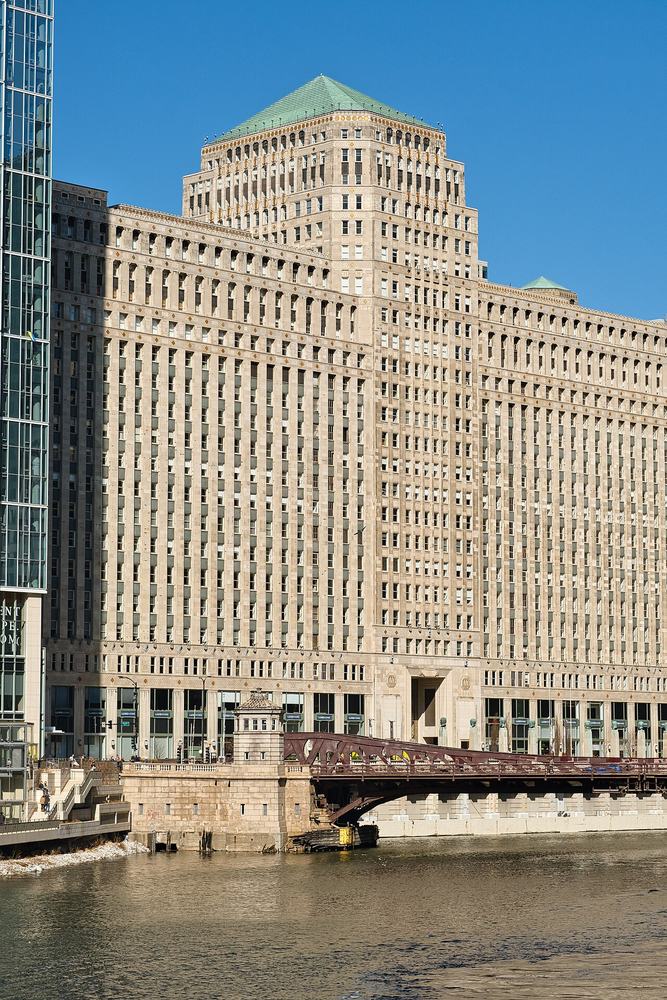
The Merchandise Mart filling two blocks along the river
Photo: Chris Rycroft, CC BY 2.0
1930·Graham, Anderson, Probst & White·340 ft, 25 stories at the tower·222 W. Merchandise Mart Plaza

The Merchandise Mart

Marshall Field built it as a wholesale showroom and for thirteen years, until the Pentagon, it was the largest building in the world by floor area, about four million square feet across two city blocks. It had its own ZIP code until 2008. Joseph Kennedy bought it from Field in 1945 and the family held it for half a century; the eight oversized bronze heads of American merchants along the river are his doing. Today it is THE MART, full of design showrooms, tech offices and a food hall, and on scheduled evenings Art on THE MART projects moving images across two and a half acres of the river facade, free to anyone standing on the Riverwalk.

Go: Public lobby, showrooms and food hall on weekdays and Saturdays; the projections are free from the Riverwalk, seasonally.
Sources: THE MART · Wikipedia

Five more that make the view

The list could go on for blocks. These five earn a place in any skyline tour, and every one has a story you can tell from the sidewalk.

Two footnotes

One that survived the fire, and one that started it all and is gone.

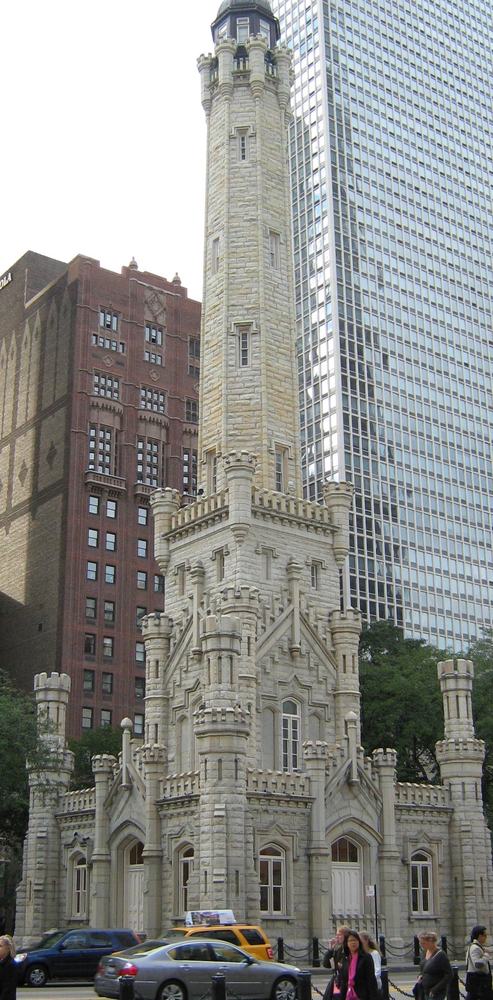
The yellow limestone Chicago Water Tower on Michigan Avenue
Photo: Zol87, CC BY-SA 2.0
1869·William W. Boyington·about 154 ft·806 N. Michigan Ave.

Chicago Water Tower

Built of yellow Joliet limestone to hide a 138-foot standpipe that smoothed out pressure surges in the city's brand new lake-tunnel water system. Two years later the Great Fire burned everything around it and left it standing, which is why a piece of plumbing became the symbol of the city's rebirth. Oscar Wilde, passing through in 1882, called it a castellated monstrosity with pepper boxes stuck all over it. It was among the very first Chicago Landmarks designated in 1971. The plaza around it is named for Mayor Jane Byrne, and the tower has hosted a small free city photo gallery inside.

Go: Outside, any time, in the middle of the Magnificent Mile; the gallery inside opens only during exhibitions.
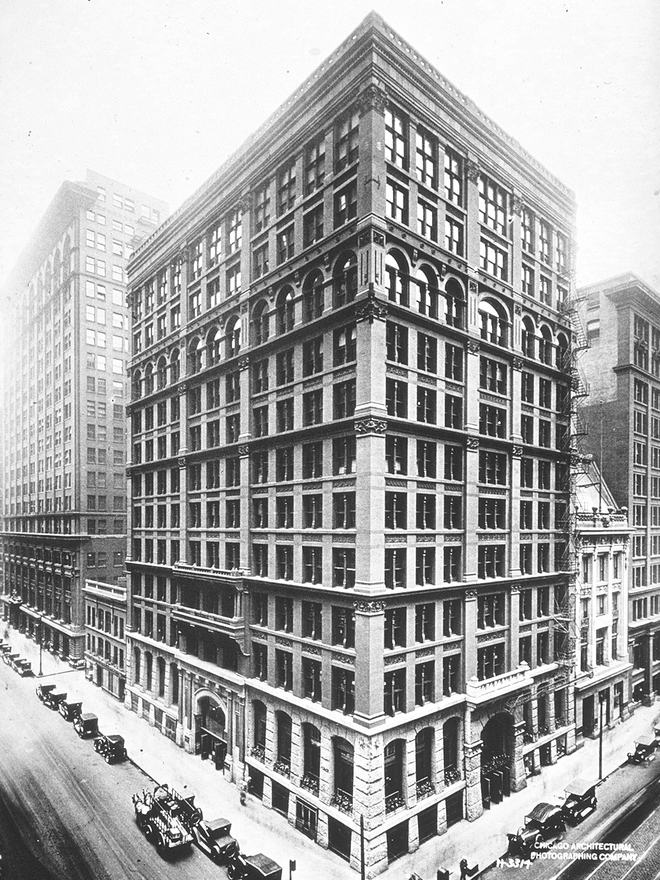
Historic photograph of the Home Insurance Building
Photo: Chicago Architectural Photographing Co..., Public domain
1885·William Le Baron Jenney·138 ft, 10 stories (later 12)·LaSalle and Adams

Home Insurance Building (gone since 1931)

Widely called the first skyscraper, because Jenney hung the outside masonry on an inside iron and steel skeleton instead of stacking heavy walls, which made the building about a third the weight of a masonry block the same size and let windows get bigger. City officials briefly halted construction to check that it would stand. Historians argue about the title, since the frame was a hybrid and other 1880s buildings have claims, but the idea it proved is the idea every tower on this page is built on. It came down in 1931 for the Field Building, now 135 South LaSalle, where a lobby plaque calls Jenney the true father of the skyscraper.

Go: Nothing survives; the plaque is in the lobby of 135 S. LaSalle, which has been under redevelopment.

Photos come from Wikimedia Commons under Creative Commons licenses or from the public domain; each one is credited to its photographer with a link to the original file and license. Hours, free days and access rules change often, so treat every "Go" line as a starting point and confirm on the official site before you head out.

New to Chicago, or thinking about it?

Knowing the city is most of our job. Tell us what your life needs and we will translate it into a neighborhood, a building and a block.

Talk to The Boulevard Group